





An electric skateboard for commuting should make the whole trip easier—not just the riding part. The right board depends on your round-trip distance, road surface, hills, storage space and how often you need to carry it. Within the OMW lineup, Gladius, Lancer, Hussar and Cavalry solve different versions of the daily commute.
Quick answer: which OMW commuter board fits you?
| Your daily priority | Model | Why it fits | Main tradeoff |
|---|---|---|---|
| Frequent stairs, transit or compact storage | Gladius | Shortest and lightest option here, with an integrated kicktail handle | Shorter platform and more direct street-wheel feel |
| A wider street-longboard platform for regular paved routes | Lancer | Wide deck, longer stance and the same 504Wh battery class as Gladius | Less convenient to carry than Gladius |
| More deck flex and pneumatic comfort on imperfect pavement | Hussar | More noticeable flex, segmented enclosure and stock 150mm pneumatic tires | Heavier than Gladius or Lancer |
| Longer range reserve, rough roads or regular off-road sections | Cavalry | 864Wh battery, stock 175mm pneumatics and a rigid protective alloy enclosure | At 38.5 lb / 17.5 kg, it is the least portable choice |
Start with the complete door-to-door route
Map the route you actually travel on an ordinary weekday. Include both directions, any detours, hills, rough sections and the distance you must walk while holding the board. A short ride with several flights of stairs can favor a compact board, while a longer ride with broken pavement can make larger pneumatic tires worth carrying.
- Mostly smooth pavement plus regular carrying: begin with Gladius.
- Mostly paved roads and little carrying: compare Gladius and Lancer, then decide whether compactness or a wider stance matters more.
- Cracked asphalt, patchwork roads or light gravel connectors: begin with Hussar and its stock 150mm pneumatics.
- Long, hilly or genuinely rough routes: begin with Cavalry, provided its 38.5 lb weight works for your routine.
If you are still comparing the entire lineup, use the five-model OMW electric skateboard guide. The rest of this article focuses only on commuting.
OMW commuter electric skateboard comparison
| Model | Deck size and complete-board weight | Battery | Stock wheels | Published range with stock setup |
|---|---|---|---|---|
| Gladius | Deck size: 33.5 × 9.8 inches / 850 × 250 mm Weight: 24.3 lb / 11 kg |
Samsung 50S 14S2P 504Wh |
MAD Wheelz V2 105mm | 28–34 miles / 45–55km tested |
| Lancer | Deck size: 39.3 × 10.2 inches / 1000 × 260 mm Weight: 26.5 lb / 12 kg |
Samsung 50S 14S2P 504Wh |
MAD Wheelz V2 105mm | 28–34 miles / 45–55km tested |
| Hussar | Deck size: 37.7 × 10.9 inches / 958 × 276 mm Weight: 33 lb / 15 kg |
Samsung 50S 12S3P 648Wh |
OMW 150mm pneumatic | Up to 28 miles / 45km tested |
| Cavalry | Deck size: 37.7 × 10.9 inches / 958 × 276 mm Weight: 38.5 lb / 17.5 kg |
Samsung 50S 12S4P 864Wh |
OMW 175mm pneumatic | Up to 34 miles / 55km tested |
OMW range tests use a 154 lb / 70 kg rider at about 14 mph / 22.4km/h in speed mode 2, on flat terrain with a gentle breeze at 86°F / 30°C. Your result will change with rider weight, speed, hills, stops, wind, temperature, tire pressure and wheel setup.
Do not compare the battery number alone. Hussar and Cavalry use larger pneumatic stock tires, while Gladius and Lancer use more efficient 105mm street wheels. Wheel choice changes both ride comfort and tested range. For a configuration-level comparison, read the OMW electric skateboard wheel guide.
How much commuting range do you actually need?
Start with your full round trip, not the one-way distance. Then leave a reserve for cold weather, headwinds, hills, aging batteries, unplanned errands and days when you ride faster. A published maximum is a comparison point, not a guaranteed daily result.
For example, a rider who travels six miles each way should plan around a 12-mile base trip before adding a reserve. That route fits comfortably inside the published test figures for all four boards, so portability, surface and ride feel may matter more than choosing the largest battery. As the route becomes longer or hillier, Cavalry's 864Wh capacity provides more margin, but only if you can live with its weight.
Portability is more than board weight

Gladius has a 33.5-inch deck and a complete-board weight of 24.3 lb / 11 kg, making it the clearest OMW choice for a commute that repeatedly changes between riding and carrying. Its kicktail handle helps with short carries, but 24.3 lb is still substantial—especially across a large station or several flights of stairs.
Lancer weighs only 2.2 lb / 1 kg more, but its 39.3-inch deck occupies more space. That extra length and width can be welcome while riding and inconvenient while standing in a crowded train. If transit is only occasional, Lancer's wider platform may be worth the modest weight increase. See the detailed Gladius vs Lancer commuting comparison.
Hussar and Cavalry become much harder to treat as carry-first commuters. Their advantage appears when the route allows you to ride most of the way and the larger tires or battery reserve solve a real daily problem.
Choose the ride feel you want every weekday

Gladius: compact and responsive
Gladius uses 8.5-inch Versa CNC RKP trucks and a compact carbon flexible deck. It suits riders who want precise steering and easier maneuvering in a smaller package. The shorter platform can feel lively, so new riders should begin in a low ride mode and build braking and turning skills gradually.
Lancer: wider and more planted
Lancer uses 9.25-inch forged trucks with CNC TKP baseplates and a longer, wider deck. It is the better starting point when standing room and a calm street-longboard stance matter more than maximum compactness. This is a fit recommendation, not a promise that speed wobble cannot occur; setup, bushings, rider technique, road surface and speed all matter.
Hussar: the most noticeable flex
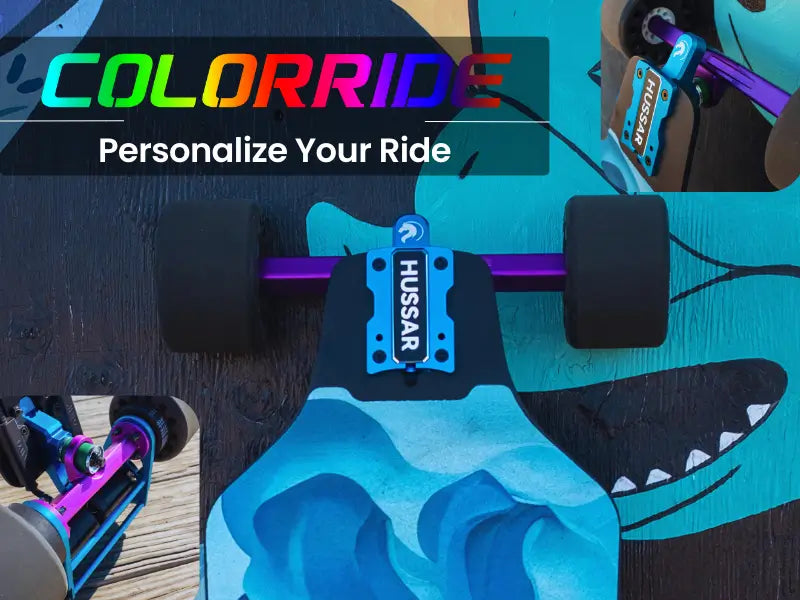
Hussar combines a flexible carbon composite deck with a segmented Chain-Whip enclosure, allowing more of the complete board to flex. That movement can reduce the harshness riders feel over imperfect pavement, especially with its stock 150mm pneumatic tires. Riders choosing between two suitable flex grades can select the higher-flex option for more comfort or the lower-flex option for a firmer, more speed-focused feel.
Cavalry: firmer support for demanding routes
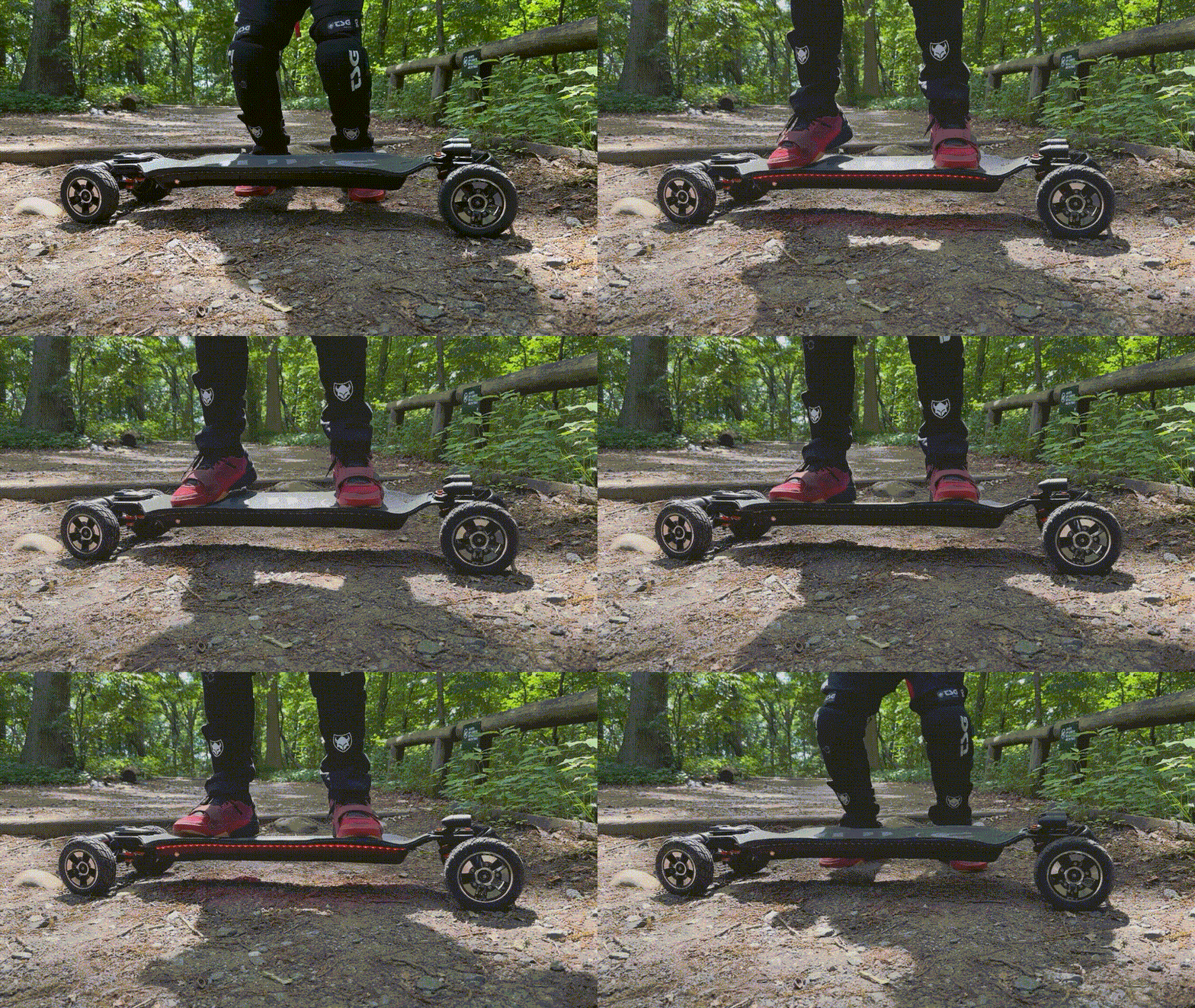
Cavalry uses a rigid protective alloy enclosure and stock 175mm pneumatic tires. Its complete-board feel is firmer than Hussar's, while the large tires provide impact isolation and clearance on rough routes. The 864Wh battery makes it the strongest range-reserve option in this group, but the benefit comes with the highest weight.
Match the stock wheel to your road surface

- MAD Wheelz V2 105mm on Gladius and Lancer: direct street feel, strong grip and efficient paved-road rolling without tire-pressure maintenance.
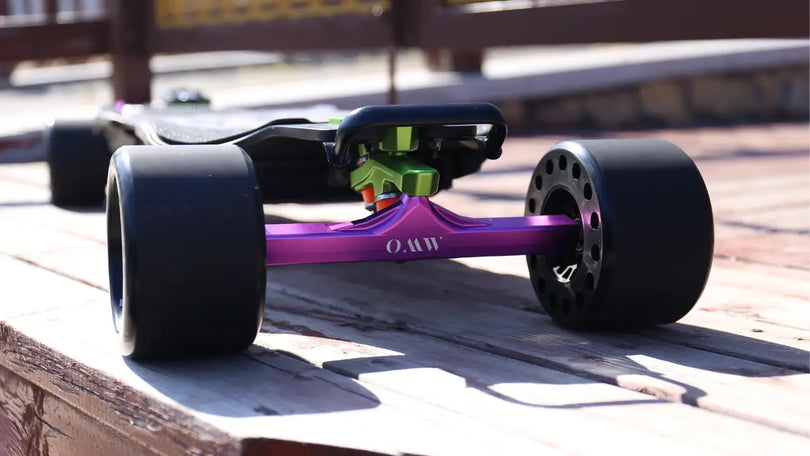
- 150mm pneumatic tires on Hussar: more cushioning for broken pavement, expansion joints and light mixed-surface sections.
- 175mm pneumatic tires on Cavalry: the most clearance here for potholes, rough roads and regular off-road sections.
Pneumatic comfort comes with ownership work: check pressure, tread and tube condition. Street wheels remove pressure checks but transmit more road texture. No wheel makes wet pavement safe, and OMW does not recommend riding in rain or on wet roads.
Four real-world commuting scenarios
1. Apartment, train and office
The ride itself is short, but the board goes up stairs, through a station and under a desk. Start with Gladius. Its compact dimensions and lower weight remove more day-to-day friction than a larger battery would.
2. Eight to fifteen miles on paved streets
The board is rarely carried and the rider values standing room. Start with Lancer for its wide street-longboard platform. Choose Gladius instead if tight storage or frequent walking is still part of the route.
3. Patchwork asphalt and comfort-sensitive feet
The route is not a trail, but cracks and repairs make small wheels tiring. Start with Hussar for its more noticeable flex and stock 150mm pneumatic tires.
4. Long route, hills and rough connectors
The rider can store the board at both ends and rarely carries it. Start with Cavalry when its larger battery and stock 175mm pneumatics solve the route more effectively than a lighter board.
Commuting safety, weather and local rules
A fast electric skateboard should not be treated like a passive transportation appliance. Wear a helmet and appropriate protective gear, learn braking distance in a controlled area, use a low ride mode while learning, and slow down before uncertain surfaces or people. Visibility equipment helps other road users see you, but it does not replace conservative riding.
Water resistance is not permission to ride in the wet. Gladius, Lancer and Hussar are rated IP55, while Cavalry is rated IP56, but OMW does not recommend riding any of them in rain or on wet roads. Water can reduce traction and braking control while increasing maintenance and electrical risk.
Electric skateboard laws vary by country, state and city, and they change over time. Check the current official rules for every part of your route. European riders can use the OMW electric skateboard laws in Europe guide as a starting point, then verify the applicable local authority.
Electric skateboard commuting FAQ
Is an electric skateboard good for daily commuting?
It can be when the route, local rules, weather, storage and rider skill all fit. The best commuting setup has enough realistic range, handles the actual road surface and remains manageable whenever it must be carried.
Which OMW board is easiest to carry on public transit?
Gladius. With a 33.5-inch deck and a complete-board weight of 24.3 lb / 11 kg, it is the shortest and lightest board in this comparison. Its kicktail handle also helps with short carries.
Should a commuter choose Gladius or Lancer?
Choose Gladius for compact storage, stairs and frequent carrying. Choose Lancer for a longer, wider street-longboard platform when you can ride most of the route. Both use a 504Wh Samsung 50S 14S2P battery and have a published tested range of 28–34 miles.
Should a commuter choose Hussar or Cavalry?
Choose Hussar when more deck flex, lower board weight and street-focused comfort matter most. Choose Cavalry when longer range reserve, rougher terrain and the stock 175mm setup matter more than portability. The full Cavalry vs Hussar comparison covers flex, enclosure, wheels and use cases.
Which OMW electric skateboard is best for heavier riders?
All four models list a maximum load of 330 lb / 150 kg, but rider weight affects range, acceleration, braking and deck feel. Cavalry is the strongest starting point when a heavier rider also needs more range reserve or rough-route capability. For any rider near the maximum load, contact OMW with weight, hills, distance and preferred riding style before ordering.
Can I commute in the rain?
OMW does not recommend riding in rain or on wet roads. An IP rating does not remove the loss of traction, longer braking distance, bearing exposure or electrical risk.
How much range should a commuter buy?
Calculate the full round trip, then add a reserve for real conditions. If your route is close to the published test maximum, choose more reserve or plan to charge at the destination rather than depending on an ideal test result.
Which OMW board is suitable for a beginner commuter?
Beginners should prioritize a manageable platform, conservative settings and protected practice—not the highest speed. Lancer offers a wide street platform; Gladius is easier to store and carry. Start in a low ride mode, learn braking before entering traffic, and use protective gear.
The final decision
Choose Gladius when carrying and compact storage shape the commute. Choose Lancer when you want a wider street-longboard platform with similar battery capacity and only a small weight increase. Choose Hussar when noticeable flex and pneumatic comfort matter most. Choose Cavalry when battery reserve and rough-route capability justify a 38.5 lb board.
If two models still look equally suitable, send OMW your rider weight, round-trip distance, steepest hill, typical road surface and how many minutes you expect to carry the board. Those five details are more useful than asking for the model with the biggest headline number.


1 comment
FinAlly
I’ve been riding a Boosted Board V2 until the beginning of this year, so I don’t have much experience with other brands to compare it to. My Gladius board arrived yesterday, and the first thing I noticed was the power. Compared to a board from 2016, it’s in a completely different league.
I mainly use it for commuting and everyday riding, and for that purpose it’s almost more powerful than I actually need. My old Boosted Board only gave me around 14 km (9 miles) of range. With the Gladius, I’ve already ridden 40 km (25 miles), and the battery still had two bars remaining.
One feature I really appreciate is the app. It lets you fine-tune both the acceleration and braking strength for each riding mode individually. Out of the box, the board has extremely strong acceleration and very aggressive brakes. I ended up setting both to around 70%, which made the throttle response and braking much smoother and easier to control. That customization made a huge difference for me.
The fastest I’ve gone so far is just over 50 km/h (31 mph). I haven’t had the courage to push it any faster yet, but up to that speed it feels very stable and inspires confidence. I also really like the longer deck—it feels comfortable and gives the board a very planted, secure ride.
Another pleasant surprise is how quiet the board is. Compared to my old Boosted Board, the Gladius is noticeably quieter while riding.
I’ve also tested it on some hills, and climbing performance wasn’t an issue at all. It handled every incline I threw at it without struggling.
My only real complaint is the weight. Even with the carrying handle, it’s still quite heavy to carry around.
Overall, I’m very impressed so far. The combination of power, range, ride quality, app customization, and quiet operation makes this feel like a huge upgrade from my old Boosted Board. I’m looking forward to putting many more kilometers on it.
I’ve been riding a Boosted Board V2 until the beginning of this year, so I don’t have much experience with other brands to compare it to. My Gladius board arrived yesterday, and the first thing I noticed was the power. Compared to a board from 2016, it’s in a completely different league.
I mainly use it for commuting and everyday riding, and for that purpose it’s almost more powerful than I actually need. My old Boosted Board only gave me around 14 km (9 miles) of range. With the Gladius, I’ve already ridden 40 km (25 miles), and the battery still had two bars remaining.
One feature I really appreciate is the app. It lets you fine-tune both the acceleration and braking strength for each riding mode individually. Out of the box, the board has extremely strong acceleration and very aggressive brakes. I ended up setting both to around 70%, which made the throttle response and braking much smoother and easier to control. That customization made a huge difference for me.
The fastest I’ve gone so far is just over 50 km/h (31 mph). I haven’t had the courage to push it any faster yet, but up to that speed it feels very stable and inspires confidence. I also really like the longer deck—it feels comfortable and gives the board a very planted, secure ride.
Another pleasant surprise is how quiet the board is. Compared to my old Boosted Board, the Gladius is noticeably quieter while riding.
I’ve also tested it on some hills, and climbing performance wasn’t an issue at all. It handled every incline I threw at it without struggling.
My only real complaint is the weight. Even with the carrying handle, it’s still quite heavy to carry around.
Overall, I’m very impressed so far. The combination of power, range, ride quality, app customization, and quiet operation makes this feel like a huge upgrade from my old Boosted Board. I’m looking forward to putting many more kilometers on it.