



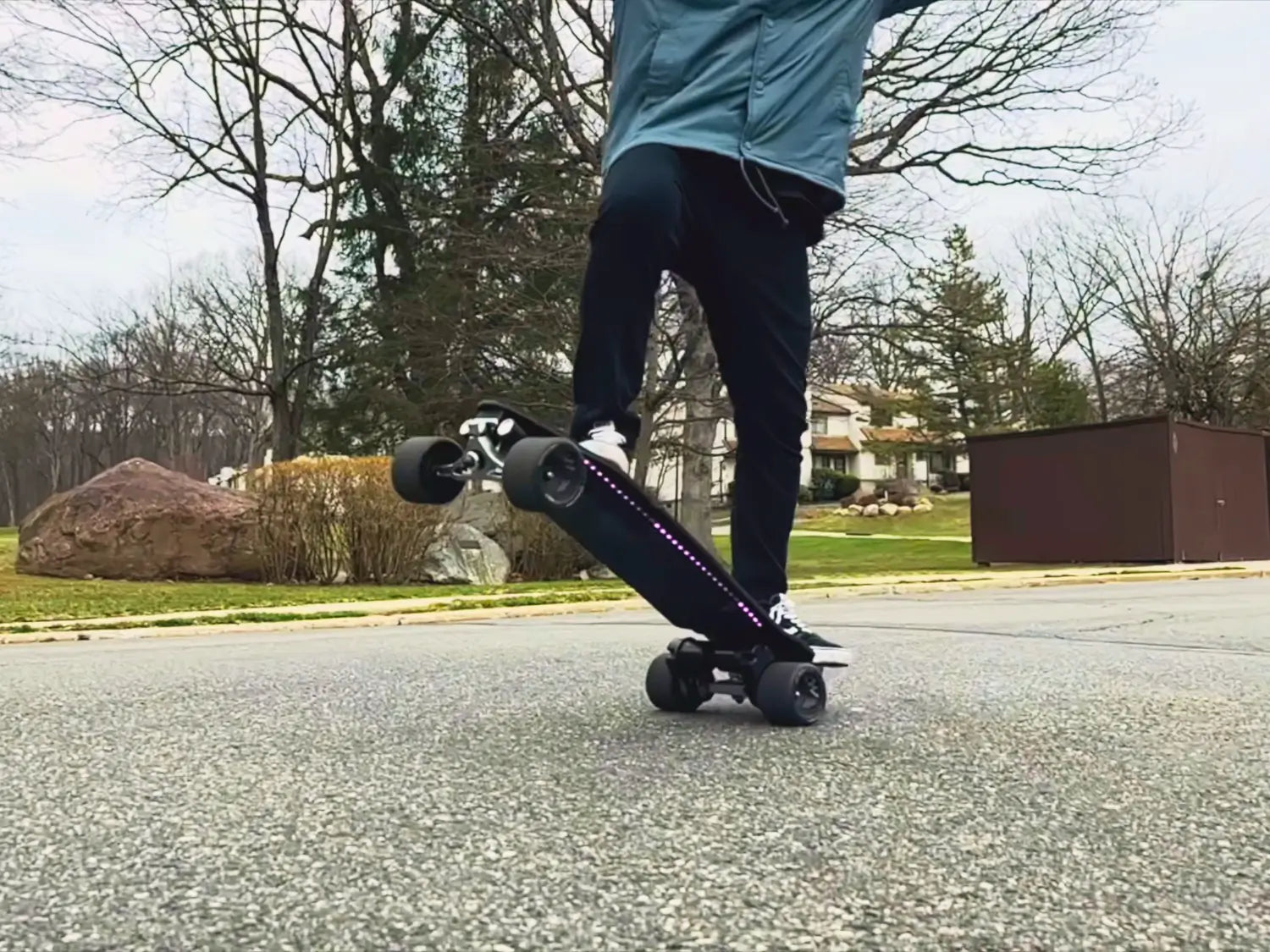
Gladius vs Lancer: the quick answer
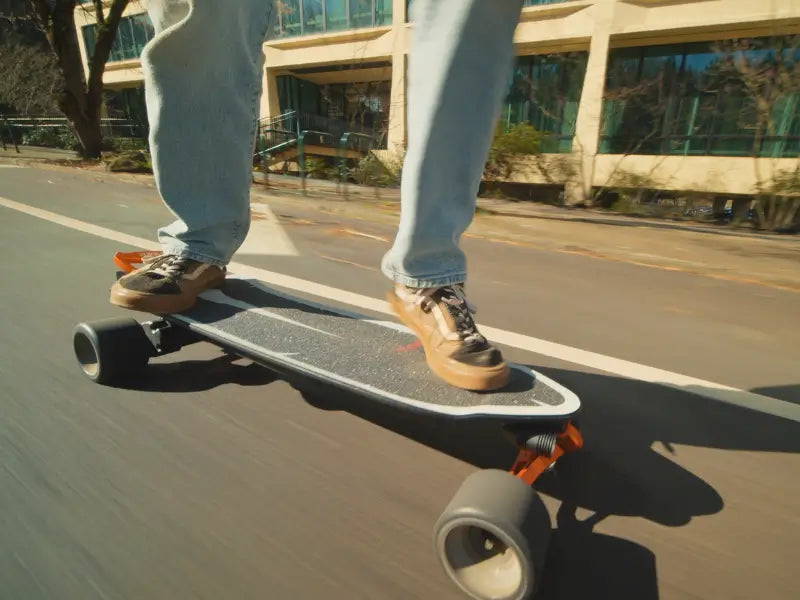
Choose the OMW Gladius when your commute includes stairs, public transport, tight storage or frequent carrying. Choose the OMW Lancer when you ride most of the route and want a longer, wider platform with more room to adjust your stance.
Both boards have flexible carbon composite decks and share the same core electrical specification: a Samsung 50S 14S2P 504 Wh battery, Hobbywing 9028 ESC and dual Hobbywing 5255 motors. Choose between them for carrying needs, stance space, flex adjustment, truck feel and wheel options—not because one has a larger battery or Gladius sacrifices that electrical platform to be portable.
For a wider comparison across all OMW models, start with the OMW electric skateboard commuting guide.
OMW Gladius vs Lancer comparison
| Decision point | OMW Gladius | OMW Lancer |
|---|---|---|
| Best fit | Mixed transit, frequent carrying, compact storage and tighter urban spaces | Mostly rideable routes, more standing room and a longboard-style platform |
| Deck size | 33.5 × 9.8 in / 850 × 250 mm carbon composite deck | 39.3 × 10.2 in / 1000 × 260 mm carbon composite deck |
| Deck flex | Flexible carbon composite in a compact portable format | Flexible carbon composite, with three wheelbase settings for High, Medium or Low Flex |
| Listed complete-board weight | 24.3 lb / 11 kg | 26.5 lb / 12 kg |
| Reference street-wheel setup | MAD Wheelz V2 105 mm | MAD Wheelz V2 105 mm |
| Battery | Samsung 50S 14S2P, 504 Wh | Samsung 50S 14S2P, 504 Wh |
| ESC and motors | Hobbywing 9028 ESC; dual Hobbywing 5255 motors | Hobbywing 9028 ESC; dual Hobbywing 5255 motors |
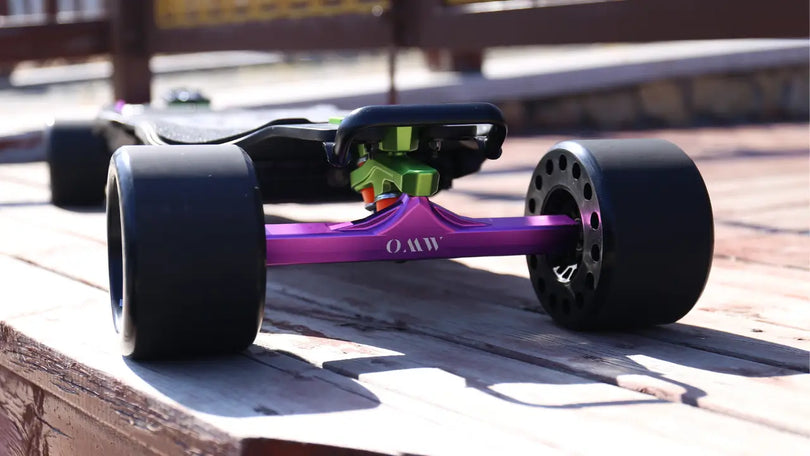
| Truck platform | Versa™ 8.5-inch CNC RKP trucks, machined from 6061 aluminum alloy | 9.25-inch forged trucks with CNC TKP baseplates |
| Daily trade-off | Easier to handle off the board, with less standing space | More room underfoot, with a larger footprint to carry and store |
Deck dimensions describe the deck, not the complete board. The listed board weights are reference figures; wheels, risers and accessories change the weight and riding height of the setup you receive.
Carrying, stairs and storage: where Gladius has the clearest advantage
The difference between 24.3 lb and 26.5 lb is only 2.2 lb / 1 kg, but deck length also changes how easily a board moves through a station, elevator, classroom or office. The Gladius deck is 150 mm / about 5.9 inches shorter than the Lancer deck, and its integrated Kickhandle combines a carrying handle with a kicktail. This makes Gladius easier to pick up, carry and maneuver off the board when a commute includes stairs or transfers.
Neither board should be treated like a lightweight non-electric skateboard. If your route includes several flights of stairs or a long walk through a station, test what carrying 24–27 lb feels like before choosing. A compact board reduces awkwardness, but it does not remove the weight of the battery and drivetrain.

Both decks flex; the platform and steering feel are different
Shared flex: portable does not have to mean rigid
Both Lancer and Gladius use flexible carbon composite decks designed to absorb road vibration and make longer rides more comfortable. Lancer balances deck movement with a longboard-style platform. Gladius brings that flexible-deck approach to a smaller board, so choosing easier carrying does not mean choosing a rigid deck.
Flex reduces harshness; it does not remove every vibration or make rough or wet surfaces safe. The meaningful choice here is how much deck space, adjustment and carrying convenience you want.
Lancer: more standing room and three flex settings
Lancer's deck size is 39.3 × 10.2 in / 1000 × 260 mm. That longer, wider platform gives you more room to reposition your feet on uninterrupted rides. Its three wheelbase settings let you choose High, Medium or Low Flex: choose more flex for greater deck movement, a lower-flex setting for a firmer platform, or Medium for a balance between them.
The 9.25-inch forged trucks with CNC TKP baseplates give Lancer direct steering and a low, connected street feel. Choose it when you prefer a longboard stance and spend more of the journey riding than carrying. Follow OMW's setup instructions when changing the wheelbase; the settings are not a reason to exceed the board's load rating.
Gladius: compact flex with responsive RKP steering
Gladius's deck size is 33.5 × 9.8 in / 850 × 250 mm, and its complete-board weight is 24.3 lb / 11 kg. Its Versa™ 8.5-inch CNC RKP trucks use machined 6061 aluminum alloy components. Together with the shorter flexible deck, they suit riders who want responsive carving in a board that is easier to carry and store.
TKP and RKP are different steering layouts, not a ranking of which board is safe. Choose Lancer for the longer platform and adjustable flex, or Gladius for compact urban carving and its Kickhandle. Practice with either setup before adding speed or riding near other people.

The same core electrical platform, not two power classes
Both boards use a Samsung 50S 14S2P 504 Wh battery, Hobbywing 9028 ESC and dual Hobbywing 5255 motors. Gladius keeps that control and braking platform in a more portable format; Lancer pairs it with a longer deck and different trucks. Do not choose Lancer solely because you expect a bigger battery, or rule out Gladius because a compact board must have weaker electronics.
Both current product listings quote a maximum speed of 31 mph / 50 km/h. That is a product specification, not a recommended commuting speed or a guarantee of stability. The shared components do not establish identical stopping distances: rider load, wheels, traction and settings still matter.
Choose Lancer for deck space, not a larger battery
Gladius and Lancer both have a 504 Wh battery. For a paved commute, start by comparing the two boards on 105 mm MAD Wheelz V2 and choose the deck and carrying format that fits your day. Lancer gives you more standing room, not extra battery capacity. The same battery specification does not prove identical range on your route.
Measure the full round trip, including detours, before ordering. Keep a battery reserve for hills, wind and cold weather rather than planning to finish at the advertised maximum. If distance is the limiting factor, compare a larger-battery OMW model instead of choosing Lancer merely because its deck is longer. The electric skateboard range calculator explains this route-first planning method. Lancer's 150 mm pneumatic conversion needs a separate range plan because it substantially reduces range compared with street wheels.
Both current product pages list a 58.8 V 4 A charger and an estimated charging time of about 2–2.5 hours. Treat that as a planning reference and do not assume a workplace or transit location permits charging.
Choose wheels for the route, then account for the tradeoff
For a paved commute, start with 105 mm MAD Wheelz V2 for grip, direct response and carving. Both boards also offer 92 mm MAD Mini for a lower, more agile smooth-street setup with less clearance.
On Gladius with 92 mm wheels, the standard 20 mm riser can be reduced to 10 mm for a lower riding position. If you prefer 125 mm MAD MAX for cruising, OMW can supply a custom Gladius build with a riser taller than the standard 20 mm. Do not fit 125 mm wheels using the unchanged stock riser; diameters above 125 mm are not recommended for Gladius.
For Lancer, choose the model-specific 125 mm MAD MAX set for paved cruising over cracks, or its dedicated 150 mm pneumatic set for mixed surfaces and light trails. The 150 mm conversion makes Lancer an all-terrain setup, but range drops substantially compared with its street-wheel configuration. Choose it for terrain comfort, not for extending a paved commute.
The OMW wheel-upgrade guide explains the choices and matched sets. The Gladius riser instructions do not apply to Lancer, and a Lancer conversion needs the Lancer-specific hardware.
OMW does not recommend riding either board in rain or on wet roads. Check local laws, transit rules and building policies before making an electric skateboard part of a daily commute.
Which board fits your commute?
Home → train or bus → office
Choose Gladius first. The shorter deck, lower complete-board weight and carrying design reduce the inconvenience of stairs, platforms and indoor storage. Confirm that your transit provider permits electric skateboards and batteries of this size.
Home → bike path → workplace, with little carrying
Choose Lancer first if you prefer a wider platform and spend most of the trip riding. Lancer has the same 504 Wh battery capacity as Gladius; choose it for stance space and longboard-style feel, not a battery upgrade.
Campus or dense urban trips with frequent stops
Choose Gladius first when maneuvering, storing and carrying happen repeatedly. If you rarely lift the board and prefer more room underfoot, Lancer can still be the better personal fit.
Longer commute on rough or mixed pavement
Choose Lancer with its dedicated 150 mm pneumatic set when mixed-surface comfort matters more than carrying convenience and your round trip allows for the substantial range reduction. For mostly paved cruising with less terrain emphasis, choose the Lancer-specific 125 mm set instead. If the route also needs substantially more range reserve, compare the larger-battery boards in the five-model buying guide.
OMW Gladius vs Lancer FAQ
Which is easier to carry, Gladius or Lancer?
Gladius is easier to manage for most mixed-transit commutes because its deck is shorter and the complete board weighs 24.3 lb / 11 kg, compared with 26.5 lb / 12 kg for Lancer. The integrated carrying design also gives Gladius a practical advantage on stairs and indoors.
Is Lancer better for long-distance commuting?
Choose Lancer when more foot space and adjustable deck flex matter on longer rides. Both boards have a 504 Wh battery, so the longer deck is not a range upgrade. Start with the 105 mm street setup for a paved commute; choose Lancer's 150 mm pneumatic set only when the terrain benefit is worth the substantial range reduction.
Does choosing Gladius mean giving up a flexible deck?
No. Both boards have flexible carbon composite decks. Gladius combines flex with a shorter deck and Kickhandle; Lancer offers a longer platform and three wheelbase-based flex settings.
Which board is better for beginners?
Either can work for a beginner when the deck size, stance and carrying needs fit the rider. Start in the lowest suitable speed mode, practice acceleration, braking and turning away from traffic, wear appropriate protective gear and learn local rules before commuting.
Can Gladius and Lancer use the same wheels?
Both offer 92 mm MAD Mini and 105 mm MAD Wheelz V2 street-wheel options. Lancer also accepts its dedicated 125 mm street and 150 mm pneumatic sets. Gladius can use 125 mm only as an OMW custom build with a riser taller than the stock 20 mm; larger diameters are not recommended. Choose the matched set for your model rather than transferring a complete conversion kit between boards.
Choose for the part of the commute that is hardest
If carrying, stairs and storage are the hardest part, choose Gladius. If most of the route is ridden and you want more room underfoot, choose Lancer. If distance, rough terrain or wheel requirements are the limiting factor, compare the route against the wider OMW range before ordering.
Read the complete OMW commuting guide | Email OMW for route and setup help