


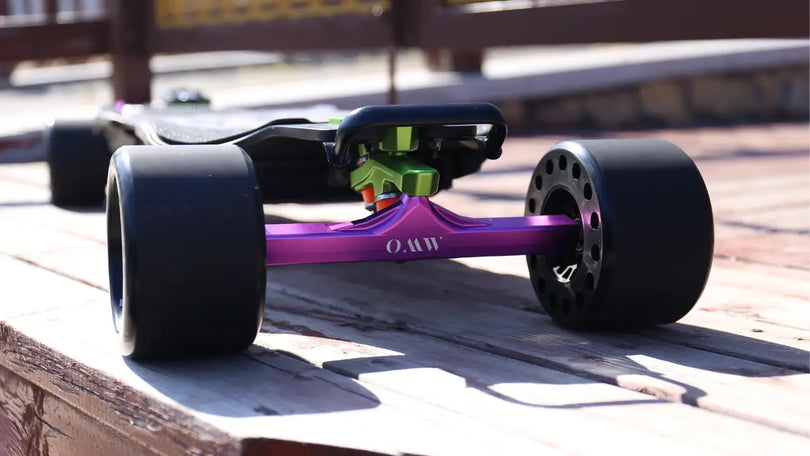
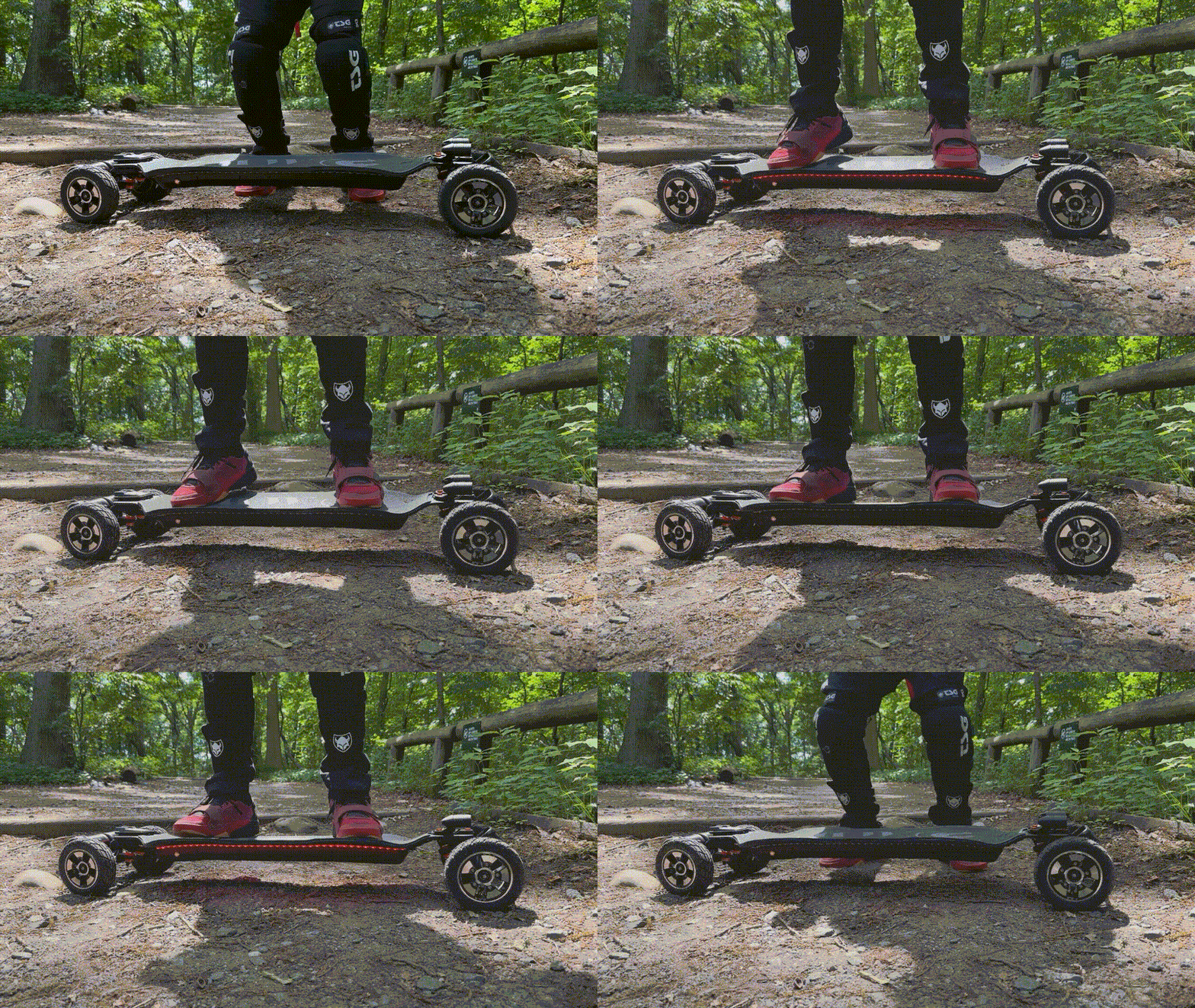

An all-terrain electric skateboard is worth choosing when your normal route includes broken pavement, gravel connectors, hard-packed dirt or other surfaces where small street wheels feel harsh or lose clearance. The right board is not simply the one with the biggest tires or the highest listed speed. It is the setup that matches your route, required range, carrying needs and willingness to maintain pneumatic tires.
Short answer: choose 150mm pneumatic wheels for a lower, street-biased mixed-terrain ride. Choose 175mm pneumatic wheels when rougher sections and obstacle clearance matter more. Within the OMW range, start with the Hussar for comfort-focused flex, street riding and light off-road use; start with the Cavalry for a larger battery, longer rough routes and more serious off-road sections.
| Your main route | Useful starting setup | Why |
|---|---|---|
| Mostly smooth pavement | 105mm or 125mm street wheels | Less tire maintenance and a more direct street feel |
| Broken pavement with gravel or dirt connectors | 150mm pneumatic | Air cushioning with a lower ride than 175mm |
| Frequent rough paths and uneven trail sections | 175mm pneumatic | More rollover ability and ground clearance |
| Paved track or high-performance street riding | Street or race-focused setup | All-terrain tires are not automatically the best choice for paved performance |
What does “all-terrain” actually mean?
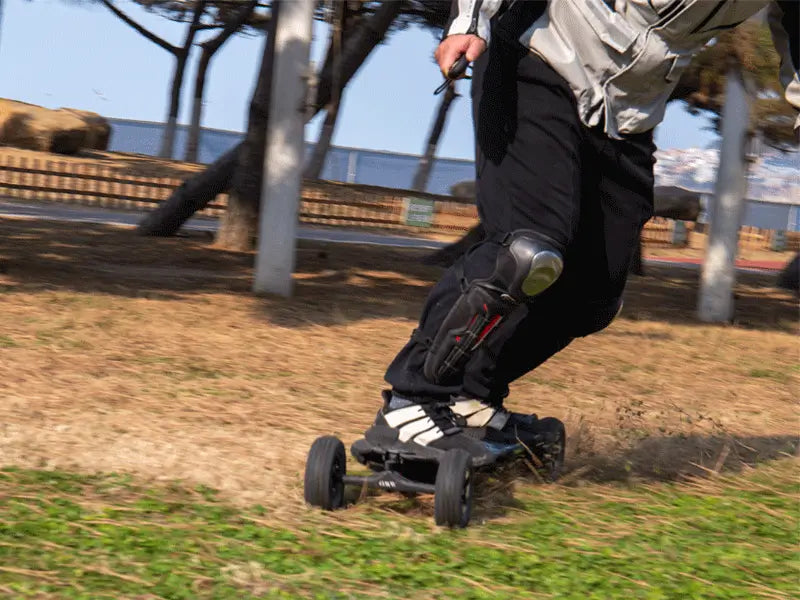
“All-terrain” is a broad category, not a promise that a board can safely cross every surface. For electric skateboards, it usually describes a full-size board with enough wheel clearance, traction, power and structure for mixed routes beyond smooth pavement. “Off-road” is often used for the rougher end of the same category.
Hard-packed dirt, maintained gravel and rough asphalt are very different from deep sand, loose rock, mud or technical mountain-bike trails. Surface conditions can also change after rain or heavy traffic. Before comparing motor numbers, write down the roughest section you will ride regularly and how long that section lasts. A short gravel connector does not require the same setup as a long, uneven trail.

Choose the wheel before you compare top speed
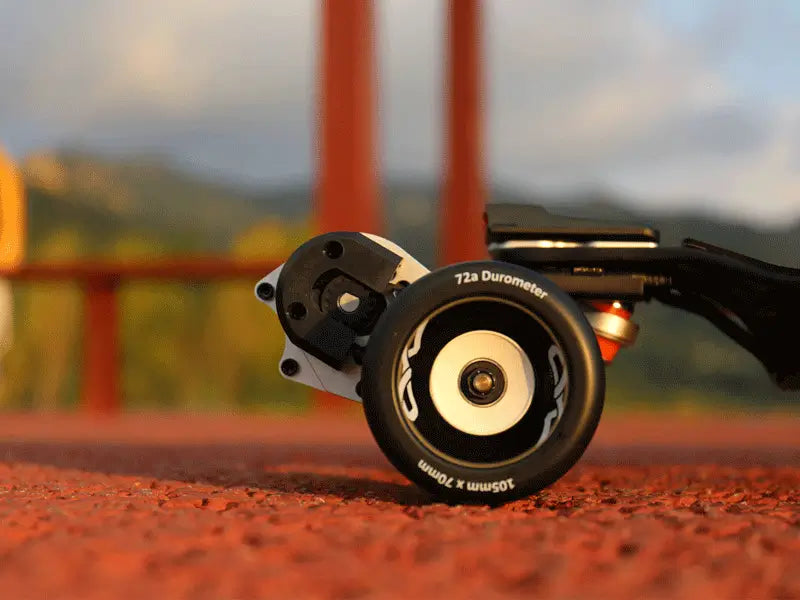
Wheel type changes how an electric skateboard feels more immediately than many headline specifications. Pneumatic tires place an air chamber between the rider and the road, helping soften square-edged cracks, stones and patchwork asphalt. They also require pressure checks and can develop punctures or tube problems.
150mm pneumatic wheels: mixed terrain with a street bias
A 150mm setup is a strong starting point when most of the route is paved but rough sections appear often. Compared with 175mm, the board sits lower and usually feels less bulky. OMW uses 150mm pneumatic wheels as the standard Hussar configuration. The current OMW pressure recommendation for these tires is 30 PSI.
175mm pneumatic wheels: more clearance for rougher routes
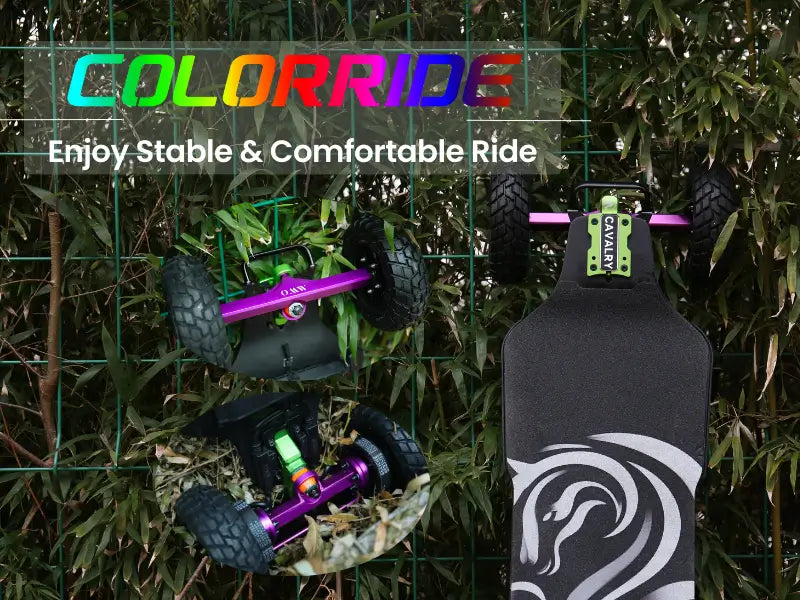
A 175mm setup rolls over larger cracks and uneven edges more easily and gives the drivetrain more clearance from the ground. The tradeoff is a taller, heavier, more terrain-focused feel. OMW uses 175mm pneumatic wheels as the standard Cavalry configuration. The current OMW pressure recommendation for these tires is 36 PSI.


If your route is almost entirely paved, a large street wheel may be the better answer. MAD Wheelz V2 105mm emphasizes grip and precise carving, while MAD MAX 125mm offers a smoother cruiser feel and strong free roll. The OMW electric skateboard wheel guide compares the full range of current choices.
Plan range for the wheel setup you will actually use
Published range is useful only when the wheel configuration and test conditions are stated beside it. Pneumatic tires normally trade some efficiency for cushioning and mixed-surface capability. Tire pressure, rider weight, hills, repeated starts, temperature, wind and riding speed can all change the result.
For route planning, measure your full trip rather than only the one-way distance, then leave a reserve for detours and changing conditions. If the route regularly approaches the board's tested maximum, choose more battery capacity or shorten the planned ride; do not assume a maximum result will repeat on every trip.
| OMW stock setup | Battery | Published test maximum |
|---|---|---|
| Cavalry with 175mm pneumatic wheels | Samsung 50S 12S4P, 20Ah, 864Wh | 34 miles / 55km |
| Hussar with 150mm pneumatic wheels | Samsung 50S 12S3P, 15Ah, 648Wh | 28 miles / 45km |
OMW test conditions: a 154lb / 70kg rider at about 14mph / 22.4km/h in speed mode 2, on flat terrain, with a gentle breeze at 86°F / 30°C. These are maximum test results, not guaranteed real-world range.
Deck feel, enclosure design and weight all matter
Tires absorb sharp impacts, but the complete-board structure determines how much movement the rider feels over longer sections of rough ground. A more flexible system can take the edge off repeated road vibration. A firmer system can feel more supported when the route becomes faster or more demanding. Neither approach is universally better.
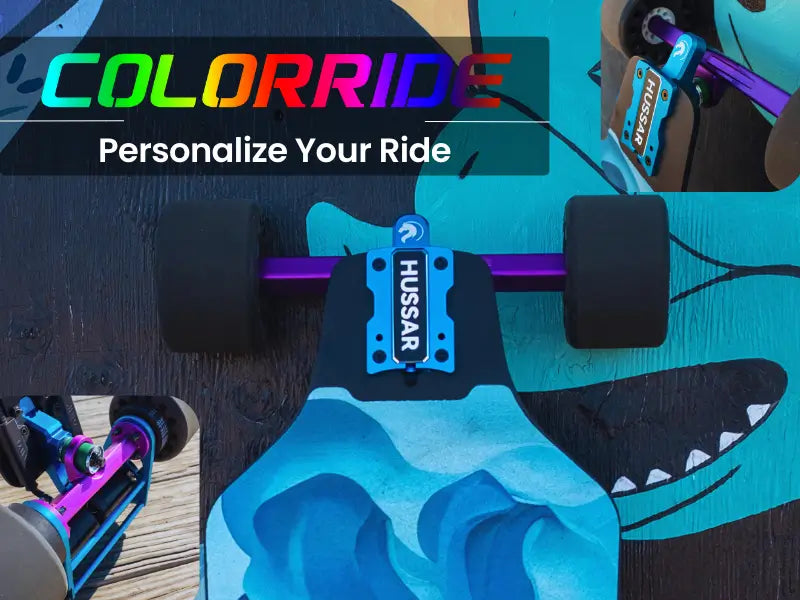
The OMW Cavalry and Hussar use the same deck size: 37.7 × 10.9in / 958 × 276mm carbon composite decks. Their complete-board feel differs because the enclosures are different. Cavalry pairs its flexible deck with a rigid protective alloy enclosure, creating a firmer overall platform. Hussar uses a segmented Chain-Whip enclosure that follows more of the deck's movement, so its flex is easier to feel.
Weight is part of the buying decision. Cavalry weighs 38.5lb / 17.5kg; Hussar weighs 33lb / 15kg. Both include handles, but neither is a compact carry board. If your route includes stairs, public transport or frequent loading into a car, the 5.5lb / 2.5kg difference is meaningful.
For reference, the complete-board dimensions of the stock Cavalry with 175mm wheels are 44.5 × 12.7 × 6.9in / 1130 × 325 × 175mm. The stock Hussar with 150mm wheels measures 44.5 × 12.7 × 5.9in / 1130 × 325 × 150mm. Complete-board height changes with the installed wheel configuration.
Look beyond motor wattage
Motor power matters on hills and loose surfaces, but a wattage number alone does not tell you how controllable a board will feel. Battery voltage, current limits, gearing, wheel diameter, controller tuning, rider weight and traction all influence acceleration and hill performance.
Before buying, look for adjustable speed and braking modes, a remote with clear status information, replaceable belts and pulleys, and a manufacturer that documents compatible drivetrain parts. New riders should begin in a lower speed mode and practice acceleration and braking on a dry, open surface before entering mixed terrain.
On Cavalry and Hussar, the standard 150mm and 175mm pneumatic configurations use a 55T wheel pulley with a 335-5M belt. Riders who want stronger acceleration can choose the 60T metal pulley with a 355-5M belt. The larger pulley changes the gearing and must be paired with the correct belt; never order a replacement from wheel diameter alone. Use the OMW belt size guide to verify the full combination.
Cavalry or Hussar: which all-terrain board fits you?
| Decision | Choose Cavalry | Choose Hussar |
|---|---|---|
| Main terrain | Rough mixed routes and more serious off-road sections | Street, commuting, carving and light off-road use |
| Ride feel | Moderate flex with a firmer complete-board structure | More noticeable deck movement |
| Range priority | Larger 864Wh battery and longer published test range | 648Wh battery with lower complete-board weight |
| Carrying | Best when carrying is infrequent | The easier of the two to lift and load |
| Stock wheels | 175mm pneumatic | 150mm pneumatic |

The full Cavalry vs Hussar comparison covers wheel options, deck-flex weight bands, lighting and published range figures in more detail. If you are also considering compact or street-focused models, use the five-model OMW electric skateboard guide.
Understand all-terrain maintenance before buying
An all-terrain electric skateboard needs more routine attention than a small street-wheel setup. That is not a flaw; it is part of using pneumatic tires and a belt drivetrain on rougher surfaces.
- When fitting OMW tires to another brand's hub: confirm that the hub is 50mm wide and ask OMW to verify the bead-seat and mounting fit before installation.
- Before each ride: inspect tire pressure, tread, sidewalls, wheel fasteners, belts and visible damage.
- After rough or dusty rides: remove debris and inspect the pulleys, belts and bearings. Do not direct high-pressure water at the board.
- After changing wheels or pulleys: confirm belt alignment, free rotation and clearance, then update wheel diameter and drive ratio in the remote or Tuya Smart App so speed and distance display correctly.
- Carry spares when the route is remote: the right tools, spare belts and tire repair items are more useful than a headline specification when a problem occurs far from home.
- Keep a range reserve: rough surfaces, low pressure, hills and frequent acceleration can all increase energy use.
Can an all-terrain electric skateboard be ridden in rain?
All-terrain capability does not mean wet-weather approval. Cavalry is rated IP56 and Hussar is rated IP55, but OMW does not recommend riding either board in rain or on wet roads. Water resistance describes enclosure protection under controlled conditions; it does not remove reduced tire grip, longer braking response, bearing exposure or the possibility of water damage.
If conditions change during a ride, reduce speed and leave the road rather than treating tire tread or an IP rating as permission to continue.
All-terrain electric skateboard FAQ
Is an all-terrain electric skateboard the same as an off-road electric skateboard?
The terms overlap. “All-terrain” usually includes mixed street, gravel and hard-packed routes, while “off-road” often implies rougher and more frequent unpaved riding. Neither term guarantees suitability for deep sand, mud, loose rock or technical trails.
Are 150mm or 175mm wheels better?
Choose 150mm pneumatic wheels for a lower, street-biased mixed-terrain setup. Choose 175mm pneumatic wheels when clearance and rollover on rougher sections matter more. Your route is more important than choosing the largest diameter.
Which OMW all-terrain electric skateboard has the longer range?
Cavalry has the larger battery and longer OMW-published test range. With its stock 175mm pneumatic wheels, its published test maximum is 34 miles / 55km. Hussar's stock 150mm pneumatic setup is tested up to 28 miles / 45km under the same stated conditions. Real range varies.
Which OMW all-terrain board is more comfortable?
Hussar provides more noticeable deck movement because its segmented Chain-Whip enclosure follows the flexible deck. Cavalry still has deck flex, but its rigid alloy enclosure creates a firmer complete-board feel. Comfort also depends on tire pressure, deck-flex selection, stance, speed and road surface.
Is an all-terrain electric skateboard suitable for a beginner?
A new rider can learn on a suitable all-terrain board, but these boards are heavy and powerful. Start in a low speed mode, wear protective equipment, practice controlled braking on dry open pavement and move to rougher surfaces only after basic control is consistent.
Can OMW 150mm and 175mm tires fit another electric skateboard?
OMW 150mm and 175mm replacement rubber pneumatic tires are compatible with most 50mm-wide wheel hubs used on electric skateboards. Because hub and bead-seat designs can differ, confirm the exact hub dimensions and mounting fit with OMW before ordering. With correct inflation and normal riding on ordinary roads, OMW guarantees that the tire tread will not be worn flat within 2,000 miles; punctures, cuts, impact damage, incorrect pressure, burnouts and intentional sliding are excluded.
Do pneumatic tires need regular maintenance?
Yes. Check pressure and tire condition before riding, carry appropriate spares for remote routes and inspect tubes, hubs and fasteners when you notice pressure loss or vibration. OMW currently recommends 30 PSI for its 150mm tires and 36 PSI for its 175mm tires.
The simplest way to choose
Buy an all-terrain electric skateboard for the route you ride every week, not for the most extreme surface you might cross once. Choose the wheel size first, calculate realistic round-trip range with a reserve, then decide how much board weight and maintenance fit your routine.
Choose OMW Hussar for comfort-focused flex, street use and light off-road routes. Choose OMW Cavalry for its larger battery, 175mm stock wheels and rougher or longer mixed-terrain rides.